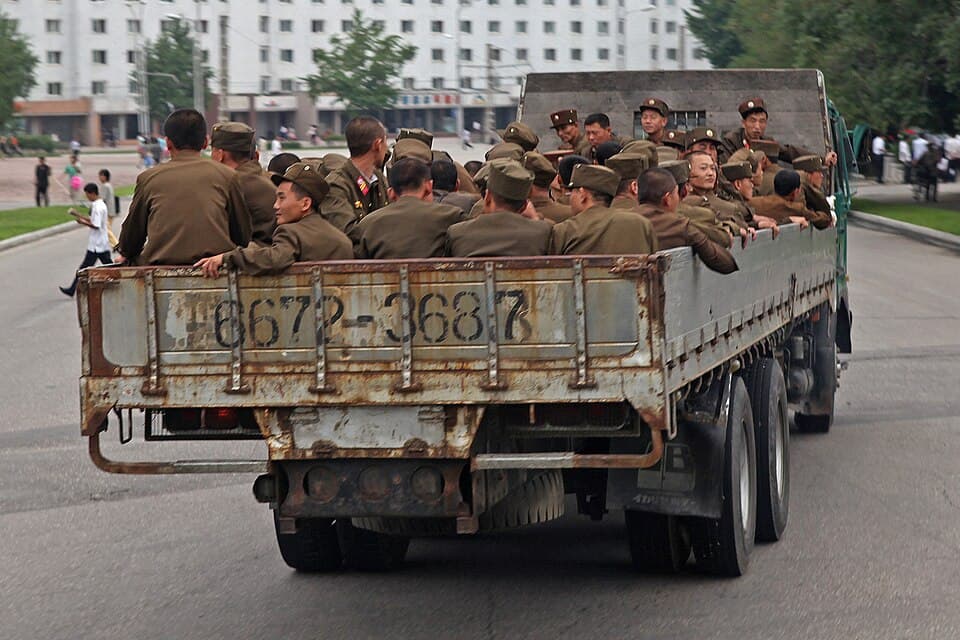
North Korean authorities recently discharged a military officer stationed in Hamhung after discovering that his wife has a relative in China who is an ethnic Korean-Chinese. The abrupt dismissal has fueled suspicion inside his unit that a power struggle over his position, not the relative, was the real motive.
A source in South Hamgyong province told Daily NK on Thursday that the officer served in the rear services department of a division under the army’s Seventh Corps, a regional army command and only learned of his wife’s Chinese relative when his commanders informed him of the discharge.
When the officer married, background investigators screened his wife and her immediate family without flagging any issues. The relative’s status in China went unmentioned throughout his subsequent years of service.
The officer reached his rank through an unusual path within North Korea’s military. He enlisted as an ordinary soldier and served as a clerk in the rear services department and later became an officer without attending a military academy. That route is known informally in North Korea’s military as a jikbal, or direct promotion. Such promotions typically trigger a thorough background check of the candidate and his family.
Even so, background checks for officers outside the political and security departments tend to be narrower, the source said. Investigators closely scrutinize a spouse and immediate family, but they rarely trace distant relatives. That gap is why the Chinese relative went unnoticed for years.
The belated discovery struck colleagues and the officer himself as suspicious. The same relative, after all, had raised no concern at his wedding or during his years of service. “People here find it hard to believe he was discharged now over a background issue that never came up before,” the source said. “Some have said someone else may have needed his position.”
Rivalry may explain North Korea military officer’s discharge
Rear services officers tend to draw envy from colleagues in other departments, the source said. The rear services department manages a unit’s food, clothing and other supplies. That role leaves its officers widely seen as enjoying more comfortable living conditions than their peers.
“Officers in the political department and the security department have always viewed rear services officers with some resentment because they live so well,” the source said. The political department oversees ideological education within the unit, while the security department monitors loyalty and internal threats. “Because of that, families of rear services officers are careful even about how they dress, so as not to draw attention from other officers’ families,” the source added.
The officer’s background may have made him a bigger target for envy than most. It is unusual for an officer promoted directly from the ranks to reach a division-level rear services post, and most officers in such positions trained at a military academy instead, the source said.
“Reaching the division level as a jikbal officer usually requires some backing,” the source said. “There’s a growing view that a power struggle between officers played a role in his discharge.”
It remains unconfirmed whether internal rivalries among officers, or tensions between their families, directly influenced the discharge, the source said.
Reporting from inside North Korea
Daily NK operates networks of sources inside North Korea who document events in real-time and transmit information through secure channels. Unlike reporting based on state media, satellite imagery, or defector accounts from years past, our journalism comes directly from people currently living under the regime. We verify reports through multiple independent sources and cross-reference details before publication.
Our sources remain anonymous because contact with foreign media is treated as a capital offense in North Korea — discovery means imprisonment or execution. This network-based approach allows Daily NK to report on developments other outlets cannot access: market trends, policy implementation, public sentiment, and daily realities that never appear in official narratives.
Maintaining these secure communication channels and protecting source identities requires specialized protocols and constant vigilance. Daily NK serves as a bridge between North Koreans and the outside world, documenting what’s happening inside one of the world’s most closed societies.