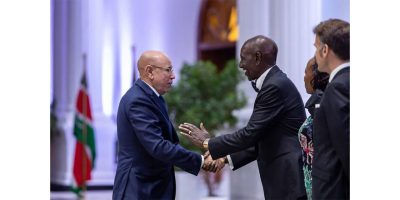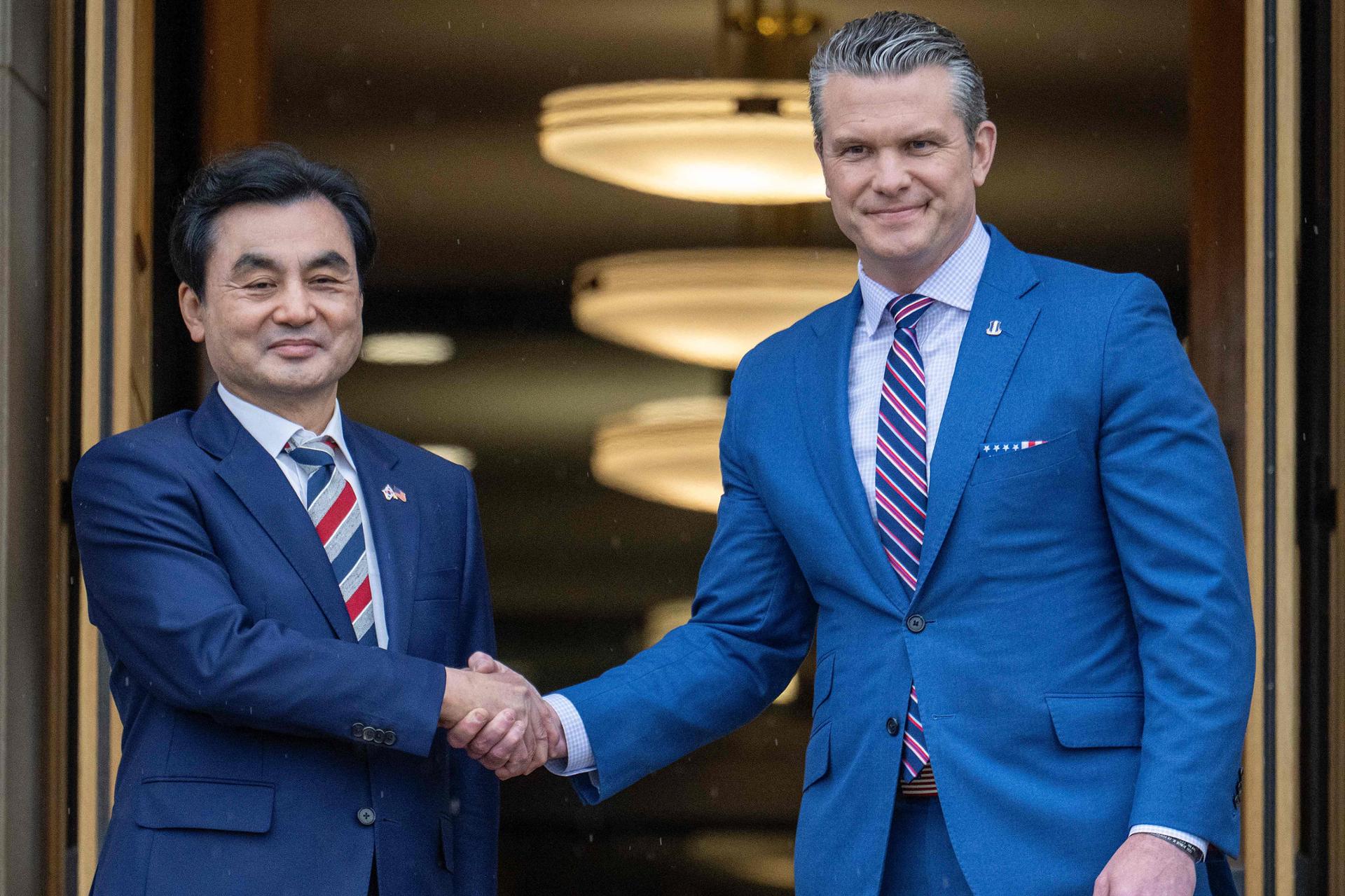
Defense Minister Ahn Gyu-back, left, shakes hands with U.S. Secretary of Defense Pete Hegseth at the Pentagon in Washington, D.C., Monday (local time). AFP-Yonhap
South Korea and the United States have agreed to work together to strengthen cooperation in areas of “mutual security interest,” including Seoul’s push to retake wartime operational control (OPCON) from Washington and joint efforts to modernize the alliance.
Defense Minister Ahn Gyu-back and U.S. Defense Secretary Pete Hegseth expressed the commitments during their talks at the Pentagon on Monday (U.S. time) as Seoul seeks to regain wartime command from the U.S. as part of broader efforts to build a more self-reliant defense.
“Both the secretary and the minister agreed to remain in close contact and further cooperation in areas of mutual security interest,” according to a joint readout released by the Pentagon.
“The two leaders also discussed key alliance issues, including wartime operational control transition and alliance modernization, and resolved to strengthen cooperation moving forward,” it said.
President Donald Trump’s administration has stressed increased burden-sharing for allies and called on Seoul to take primary responsibility to deter North Korea with “critical but more limited” U.S. support.
The talks came amid apparent differences between the two sides, after U.S. Forces Korea commander Gen. Xavier Brunson told Congress last month that the allies aim to meet the conditions for the OPCON transfer by no later than the first quarter of 2029.
Seoul is reportedly targeting 2028 for the OPCON transfer, while both presidents are still in office, indicating that the two sides may have different timelines for the transition.
U.S. Secretary of Defense Pete Hegseth hosts South Korean Minister of National Defense Ahn Gyu-back for bilateral talks at the Pentagon in Arlington, Virginia, Monday (local time), in this Getty Images photo. AFP-Yonhap
During the talks, the defense chiefs “reaffirmed the important role” of the Korea-U.S. Integrated Defense Dialogue (KIDD), a key bilateral consultation platform handling the wartime OPCON issue, to “advance alliance cooperation and both countries’ national interests,” the readout said.
The biennial KIDD meeting is scheduled to take place in Washington on Wednesday and Thursday.
Ahn also highlighted South Korea’s latest efforts to “increase its defense spending, secure critical national defense capabilities and lead the defense of the Korean Peninsula,” the statement said.
Hegseth “underscored the importance of modernizing the alliance while adopting a clear-eyed and pragmatic approach to deter threats and enhance the combined U.S.-ROK defense posture,” it said. The ROK is short for the Republic of Korea.
In this vein, the two sides likely discussed Seoul’s push to build nuclear-powered submarines amid little progress since Trump gave the green light to the move during his summit talks with President Lee Jae Myung in October last year.
A defense ministry official said Tuesday the nuclear-powered submarine issue was discussed.
“We emphasized it is important to produce a tangible outcome swiftly, given that the nuclear-powered submarine issue is a matter agreed upon by the leaders of the two countries,” Lee Kyung-ho, deputy defense ministry spokesperson, said in a regular briefing.
At the start of the talks, Hegseth called for South Korea and other allies and partners to support U.S. efforts in confronting threats.
“The U.S. is looking to South Korea — and all partners and allies — to stand shoulder to shoulder with this country during times of conflict,” he said, according to a separate news post by the Pentagon.
His remarks came after Seoul announced Sunday that a recent explosion and fire on a Korean-operated cargo ship in the Strait of Hormuz were caused by a strike by two unidentified flying objects.
The suspected attack has raised the possibility that Seoul may rethink its role in reducing tensions in the Middle East and shift from a cautious stance toward aligning more closely with U.S. efforts regarding the strategic waterway.
“Regarding the Strait of Hormuz, the two sides closely exchanged views on the importance of ensuring the safety of maritime shipping lanes and freedom of navigation,” the deputy spokesperson Lee said.
“Our position is that we will review our measures in phases and pursue them (accordingly),” he said, without elaborating.
Cheong Wa Dae “strongly” condemned the recent attack on the Korean cargo ship Monday, saying that Seoul will continue to join international efforts to ensure the security of all vessels, including Korean ships, and their safe passage.
The joint readout did not include any details on discussions about the Strait of Hormuz or related U.S. initiatives.
Ahn was on his five-day trip to the U.S. this week, during which he also plans to meet with the acting secretary of the U.S. Navy and U.S. senators on the armed services committee.