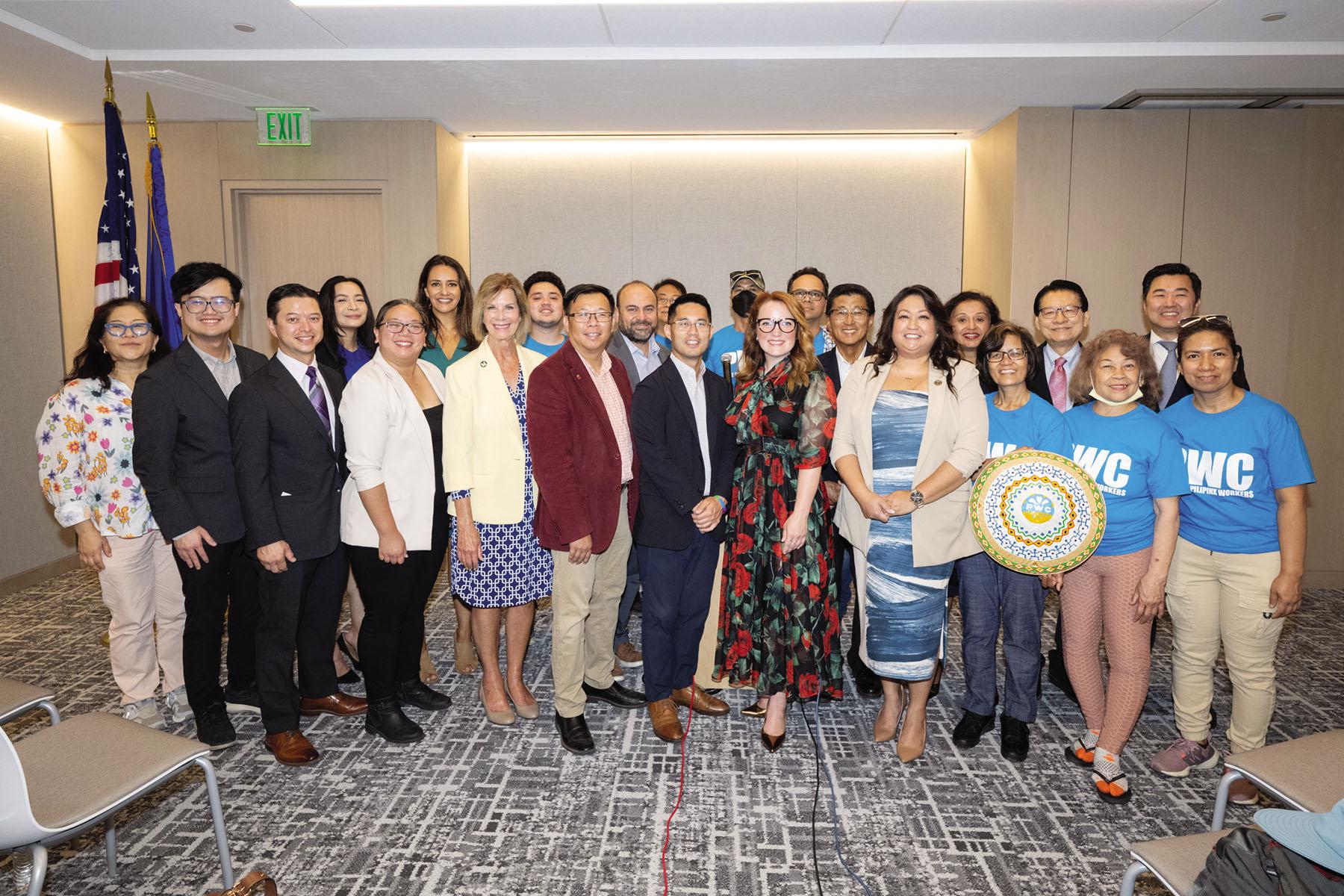
Photo courtesy of the Office of LA County Supervisor Lindsey Horvath
A proposal to expand the Los Angeles County Board of Supervisors has garnered support from Asian American and Pacific Islander (AAPI) elected officials, who say that doing so could lead to the creation of a special district for the community.
Prominent AAPI congressmembers, Rep. Ted Lieu (CA-36) and Rep. Judy Chu (CA-28), joined county supervisors during a press conference on Thursday, July 18 to support a governance and ethnics reform package for LA County.
The proposal, introduced by County Board Chair Lindsey Horvath and Supervisor Janice Hahn, seeks to create an elected county executive position, expand the Board of Supervisors from five to nine, and establish ethics reforms.
“This expansion is not just a structural adjustment, it’s a crucial step toward ensuring that our government truly represents the rich diversity of our region,” Chu said at the press conference. “LA County is home to more Asian Americans than any other county in the United States, with close to 1.5 million AAPIs living here.”
Chu added that despite LA County being “home to 14 Asian majority suburbs,” “there is not a single person who is AAPI who sits on the Board of Supervisors.”
Hanh, in a statement, said that the AAPI community would benefit from smaller district as “no one district has an AAPI majority.”
“But if the proposal Supervisor Horvath and I have put forward passes – that could change,” said Hahn, who represents the county’s fourth district, which covers cities like Cerritos, Artesia and Long Beach. “We want to expand the board from five districts to nine – not because we want bigger government, but because we want better, more representative government. We want to make sure more voices are in our Board room when we are deciding how to tackle the biggest challenges we face as a County. The AAPI community deserves a seat at that table.”
This proposed change would create distinct executive and legislative branches of the government through a directly elected County Executive. The elected County Executive would function much like a Mayor, Governor, or President with the Board of Supervisors serving as the legislative branch like a City Council, State Legislature, or Congress.
Beyond the three key pillars of the proposal, additional reforms include establishing a commission to review the County Charter every ten years; creating a Director of Budget and Management and a County Legislative Analyst; requiring departments to present their annual budget in open hearings; creating a task force to oversee reform implementation; and that all changes come at no additional costs to or taxes imposed on taxpayers to implement.
“The Ethics Commission will hold our elected Supervisors and County staff responsible for their own actions and remind them there are standards we must observe and abide by,” said Filipina American Artesia Councilmember Melissa Ramoso. “This creates trust, accountability, and public confidence that many resident voters are entitled to. I commend Supervisors Horvath, Hahn and Solis for their leadership and dedication to advancing these necessary changes and moving our County into the 21st century.”
At its July 9 meeting, the Board of Supervisors approved Supervisor Horvath and Hahn’s governance and ethics reform proposal. County Counsel is now drafting an ordinance to amend the Los Angeles County Charter, which was adopted in 1912 when the population was 500,000. The ordinance will return to the Board on July 23 for first reading. If approved after a second reading, the proposal will go before voters as a charter amendment ballot measure this November. (AJPress)